How to Run Your Own AI SEO Agent (No Engineer Required)

Learn how to build and control an AI SEO agent by Complete that does keyword research, tracks rankings, and drafts your reports in plain language.
If you’re a marketer, an SEO lead, or an agency running SEO for a B2B site, you can build your own AI SEO agent at Complete and instruct it in plain language to do defined SEO work: keyword research, rank tracking, content outlines, and the monthly report you keep pushing to Friday afternoon. You don’t need an engineer to run one. The pitch is obvious: hand off the routine work without handing off control of the quality. That control is the part vendor pages skip, and it’s the difference between an agent that gives you back four hours a week and one that quietly ships nonsense under your name.
What is an AI SEO agent?
An AI SEO agent is a Complete SEO Solution that carries out SEO tasks you define in plain language: researching keywords, tracking rankings, outlining content, and assembling reports from your search data. Unlike other SEO tool, which waits for you to click, an agent runs the workflow itself and brings you the result to approve.
Two things an SEO agent is not.
It’s not a chatbot. A chatbot answers when you ask. An agent has a standing job: every Monday it pulls your Search Console data, checks which queries gained impressions, and drops a shortlist of movers in front of you. You never prompted it that morning. You defined the job once.
And it’s not another dashboard subscription. Rank trackers and audit tools show you data and leave the work to you. An agent does the work: the comparison, the outline, the report draft. The tools are where the data lives. The agent is who goes and gets it.
What a well-run SEO agent actually does in a week
Here’s a working setup for a marketer running SEO for one B2B site, drawn from how we run our own.
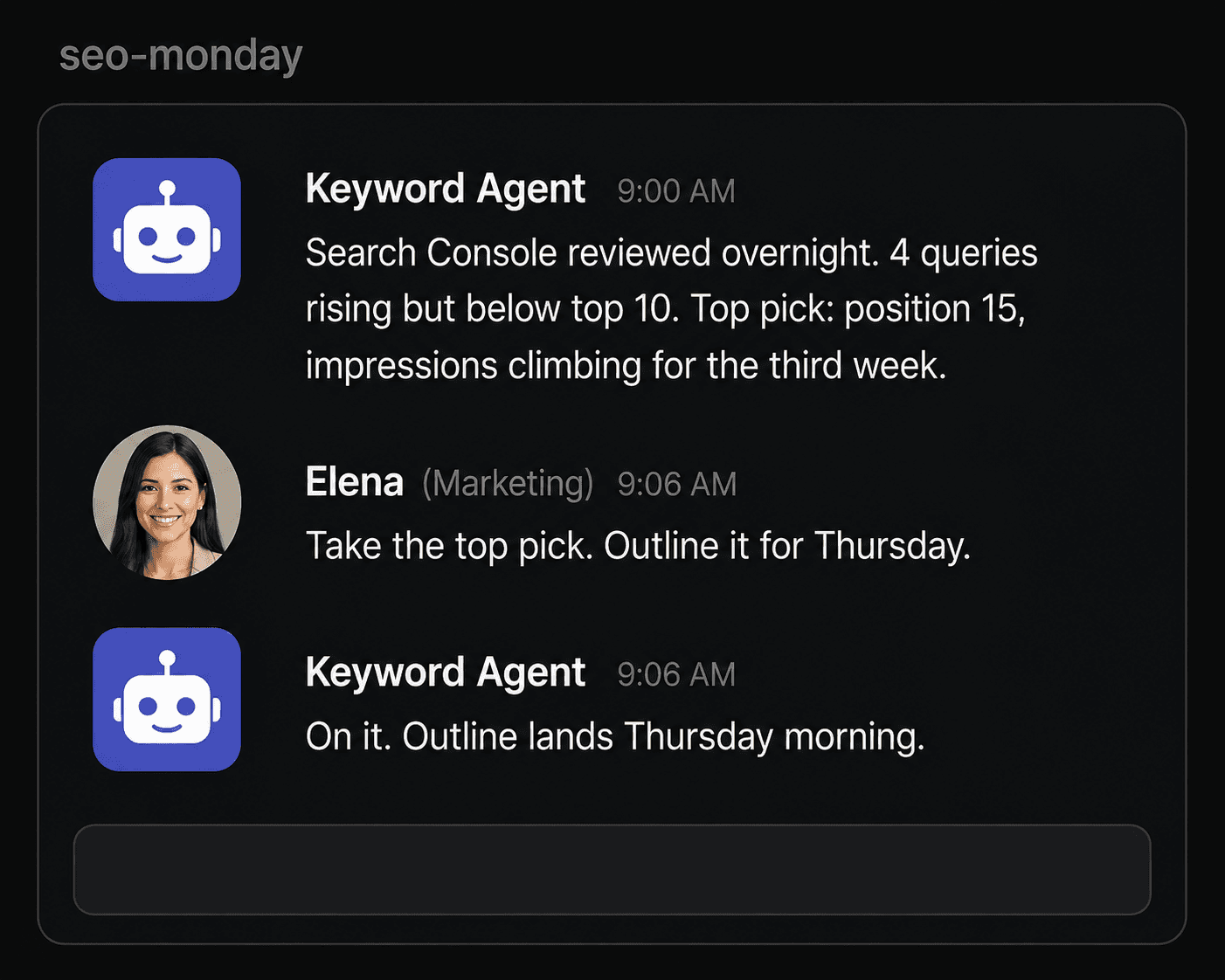
Monday, 9:00. The agent has been through Search Console overnight. It flags queries that gained impressions but sit outside the top 10, the classic “almost there” list. Last week for us that list included a category keyword sitting at position 15 with rising impressions. That’s not trivia. That’s the next content decision, made by 9:05.
Wednesday. Rank check against the keyword file. Anything that moved more than 3 positions in either direction gets a one-line note with the likely cause, backed by a quick look at what competitors published and how the SERP shifted: a rival ranked a new page, a page of yours lost its internal links, a SERP feature appeared. Silence when nothing moved. An agent that reports “all stable” in twelve paragraphs is wasting your attention.
Thursday. A content outline for one target keyword from your list: search intent, the H2s that answer it, the questions people actually ask, and where the current top results are thin. You write the article, or brief it out. The agent does the two hours of digging that used to come first.
Month-end. The report. Positions, clicks, wins, losses, next month’s plan, assembled from Search Console and Analytics into the format you defined once. This used to be the worst afternoon of the month. Now it’s a 20-minute review of a draft.
Notice what’s underneath. The files you already work in, and the reports you already run. Nothing exotic. The same agent handles the unglamorous technical layer too: flagging crawl errors, spotting internal-linking gaps, checking for duplicate titles, drafting schema. An SEO agent earns its keep on the repetitive work you know how to do, done without you sitting there.
Do AI SEO agents actually work?
Ask Google this question and the top result is a Reddit thread full of people saying: sort of, sometimes, mine broke. The skepticism is earned, and it’s worth taking seriously, because the failures follow a pattern. Three patterns, actually.
Nobody reviews the output. The agent writes meta descriptions, publishes them, and three weeks later someone notices half the site promises “Learn more about undefined.” The failure wasn’t the AI. It was shipping without a checkpoint.
The instructions were vague. “Improve our SEO” is not a job description. An agent given a vague job returns vague work, at scale, which is worse than no work.
The agent is a black box. Some tools sell an “AI SEO agent” that you can’t inspect: you see inputs and outputs and have to trust the middle. When results dip, you can’t tell whether to fix the instructions, the data, or the tool, so you churn.
All three are the same failure wearing different clothes: the person responsible for SEO wasn’t in control of the agent doing SEO. That’s an ownership problem, not an AI problem. Which leads to an opinion we hold strongly: if your SEO agent needs a prompt engineer on retainer, it’s a bad agent. The person who owns the SEO should be able to read the agent’s instructions, change them in plain English, and see every step it took.
How to build your SEO agent in plain language
This is the part that sounds technical and isn’t. Four steps.
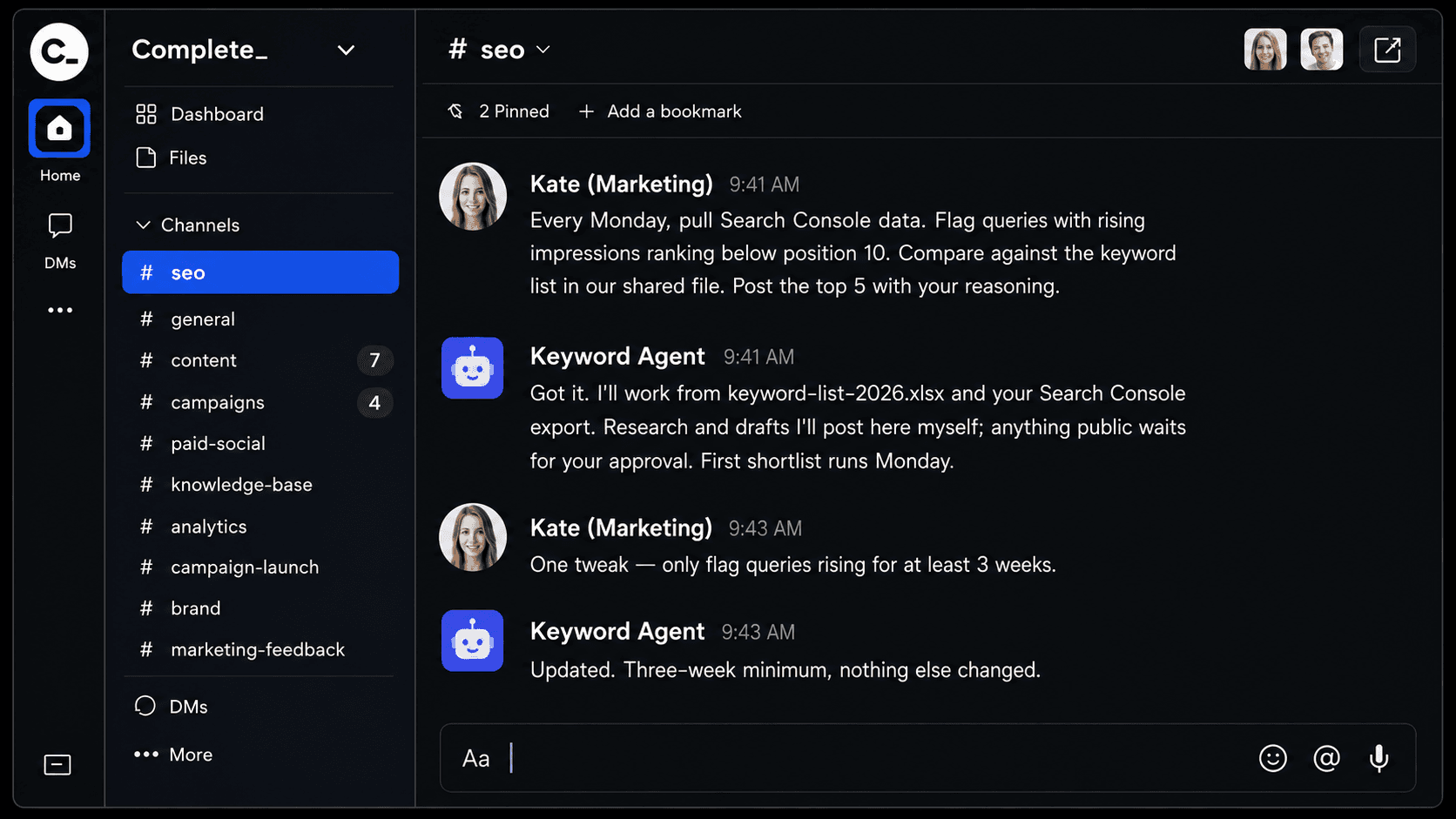
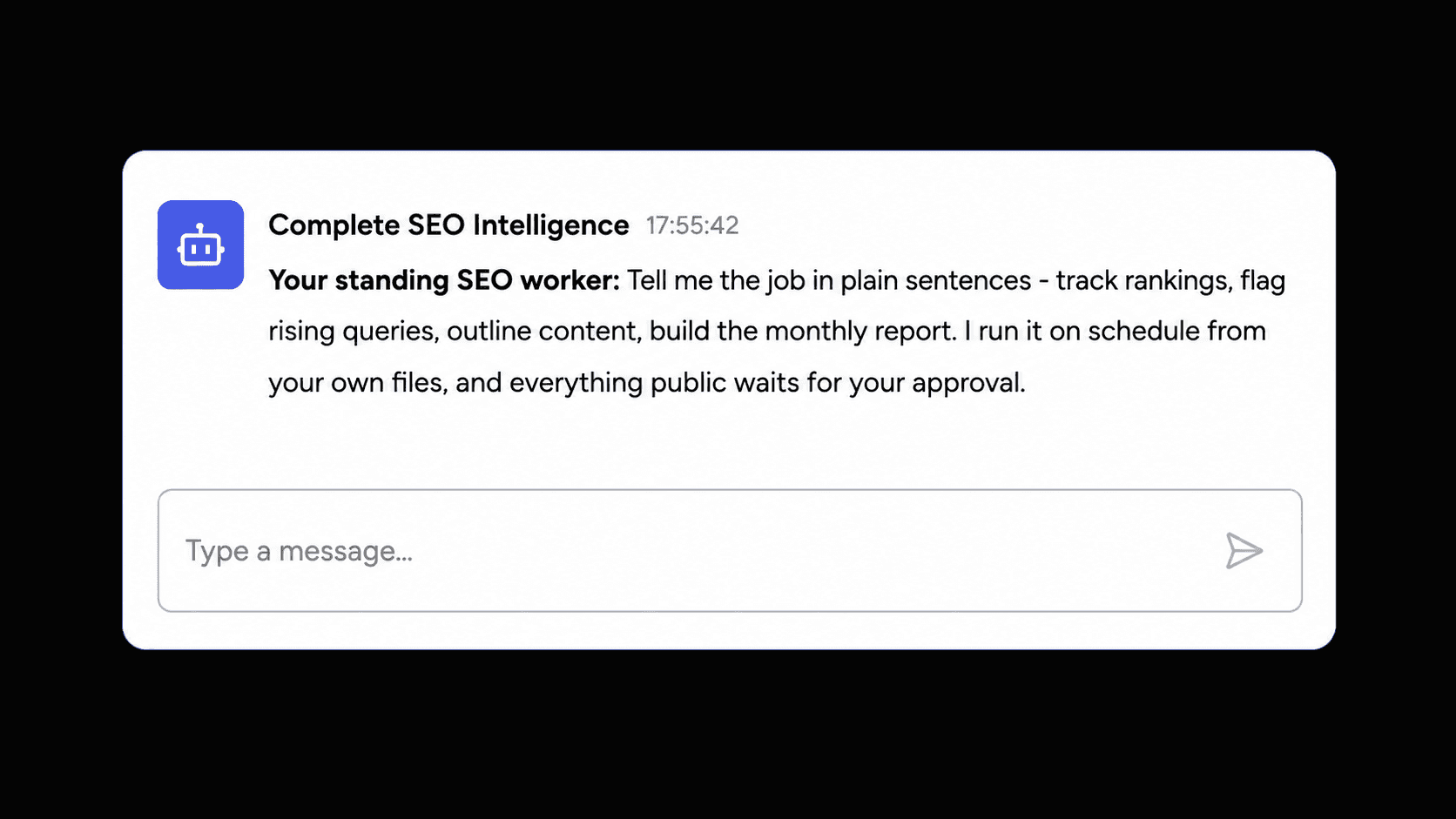
Write the job description. In plain sentences, the way you’d brief a contractor: “Every Monday, pull Search Console data for the site. Flag queries with rising impressions ranking below position 10. Compare against the keyword list in the shared file. Put the top 5 in a note with your reasoning.” If you can write that paragraph, you can build the agent. In Complete, that paragraph more or less is the agent.
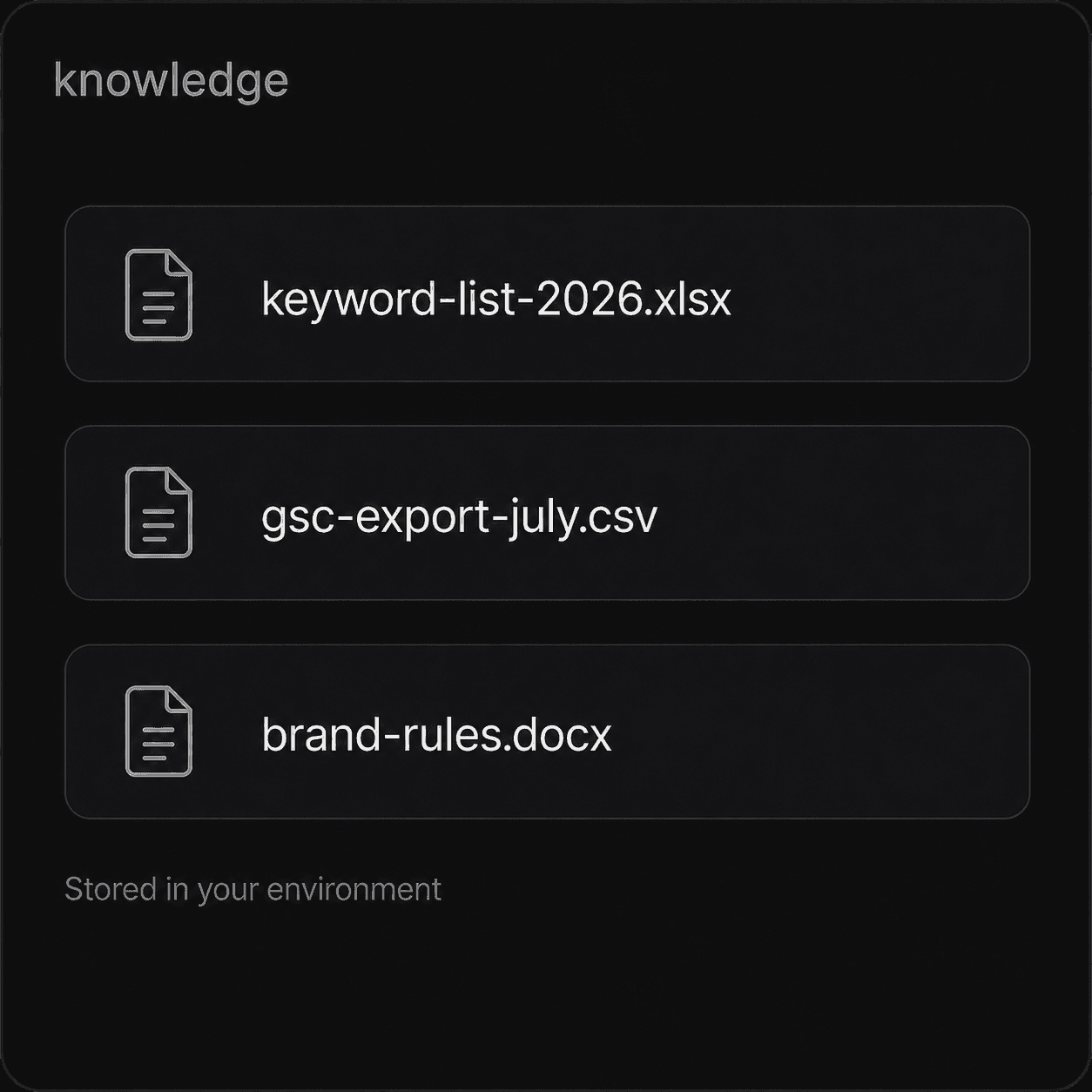
Connect the data. Your keyword spreadsheet, your Search Console and Analytics exports, your brand rules if you have them. The agent works from your files, not from its imagination. Garbage in still applies.
Set the approval points. Decide what the agent may do alone (research, drafts, internal notes) and what waits for your sign-off (anything public: published copy, meta tags, client emails). This is one setting, not a philosophy seminar. Default to approval for anything that leaves the building.
Run it for two weeks before you trust it. Check everything at first. You’ll tighten the instructions twice in the first week; that’s normal and takes minutes, because the instructions are sentences, not code. By week three you’re skimming.
What to look for in an AI SEO agent
Most comparisons of AI-powered SEO agents line up features: how many keywords, which integrations, what it costs. Useful, but it misses the thing that actually decides whether the agent works for you a year from now. That thing is control. Five questions cut through the marketing faster than any feature table.
Can you read its instructions? If the agent’s job is buried in settings you can’t see or edit in plain language, you’re renting a black box. You want to open the instructions and change a sentence without filing a ticket.
Does it show its work? When a ranking moves or a draft looks off, you need to see the steps the agent took to get there. No audit trail means no way to fix the cause, only the symptom.
Who holds the approval switch? You, or the vendor’s automation? Anything that can publish to your site or email your client without your sign-off is a liability wearing a productivity badge.
Does it work from your data? An agent reasoning over your Search Console, your keyword file, and your analytics beats one guessing from a generic model. Your files are the moat.
Does your data stay yours? This matters most for agencies handling client accounts. Check where the data goes and who else can see it before you connect a single login.
Notice that none of these are about the AI. They’re about who’s in charge of it. An agent that scores well on features and badly on these five will save you time this month and cost you trust next quarter.
What stays in your hands
A reasonable fear: does running an agent mean losing the craft? Here’s the honest split, and it’s the section to read if you’re on the fence.
The agent proposes. You approve. It drafts the outline; you decide the angle and what the article actually claims. It flags the ranking drop; you decide whether that page gets rewritten, redirected, or left alone. It assembles the client report; you write the two sentences of judgment at the top, which are the only sentences the client remembers.
What you delegate is the gathering and the formatting, the mechanical middle of the job. What you keep is taste, strategy, and the right to say no before anything ships. If a setup asks you to give up that last part, walk away from it, whatever the demo looked like.
FAQ
Can I run an AI SEO agent without coding?
Yes. In plain-language platforms, you describe the job in sentences, connect your data files, and set approval rules. If you can write a clear brief for a contractor, you can set up and run an SEO agent yourself, and change how it works whenever you want.
What data does an SEO agent need?
At minimum: Search Console access or exports, your keyword list as a spreadsheet, and analytics data for traffic context. Add brand guidelines if it drafts anything public. The agent’s output quality tracks the quality of the files you give it.
How is an SEO agent different from a popular SEO tool?
A tool shows you data when you open it. An agent has a standing job it performs on schedule: it pulls the data, does the comparison, and delivers a result for your review. Tools are where information lives. An agent is the worker that goes and gets it.
How do agencies use SEO agents for client work?
Mostly for the recurring layer: monthly client reports assembled from Search Console and Analytics, rank alerts per client, competitor research, and content briefs before production. One agent per client with that client’s files keeps data separate and reports consistent. The account lead still approves everything that goes out.
Where to start
Pick the ugliest recurring task first. For most people that’s the monthly report; for some it’s the Monday keyword triage. Write the job description for that one task, connect the two files it needs, set approval on any outgoing items, and run it for two weeks. Then judge it by one number: the hours you got back versus the corrections you had to make. If you want to see what that looks like in practice, the SEO Solution workflow in Complete shows the full setup, from job description to approved report.