Complete SEO Intelligence

Introducing a workspace where AI agents do the SEO analysis and then tell you what to act on, instead of presenting raw data for you to interpret. The difference is the output. A dashboard ends at a chart. A workspace ends at a recommendation, a brief, or a drafted fix.
Complete SEO Intelligence, AI SEO Workspace: How Three Agents Decide What to Fix Next
An AI SEO workspace is a single environment where AI agents handle the analysis, prioritization, and recommendations that used to take a crawler, an analytics tab, and a stack of spreadsheets. Complete SEO Intelligence is an AI SEO workspace built on three agents. It works on your live data, connects the tools you already use, and turns what it finds into the next brief or fix. The agents propose. You approve what ships.
The timing matters. Search behavior has changed sharply. SparkToro's widely cited study found that 58.5% of US Google searches ended without a click to an external site, and multiple 2026 trackers report the zero-click trend has been climbing since. By February 2026, BrightEdge measured AI Overviews appearing on roughly 48% of all Google searches, up about 58% year over year. When an AI Overview appears, organic click-through rates fall sharply, with Seer Interactive reporting a decline of nearly 60% on affected queries. The old playbook, rank a page and wait for clicks, no longer describes how most searches end. That changes what an SEO tool needs to do for you.
The 2026 problem: search changed, your tooling did not
Most SEO platforms were built for a world of ten blue links. They crawl your site, fill a dashboard with numbers, and leave the interpretation to you. In 2026 that gap is the problem.
Three forces make it worse:
Visibility and traffic are no longer the same metric. A brand can appear prominently in an AI answer and receive no referral click. SEO success now spans multiple surfaces, not just position one.
The data is fragmented. Search Console tells you one thing, analytics another, and your rank tracker a third. Stitching them into a decision takes hours every week.
Almost nobody is measuring the new surfaces. A 2026 Goodfirms survey of digital marketing practitioners found that 65% name AI-driven search changes as their single biggest challenge, yet only 14% track AI search visibility at all. Most teams are working blind on the fastest-growing part of search.
The result is a familiar bottleneck. You have more data than ever and less time to turn it into a decision. A dashboard does not solve this. It adds another screen to read.
What is Complete SEO Intelligence?
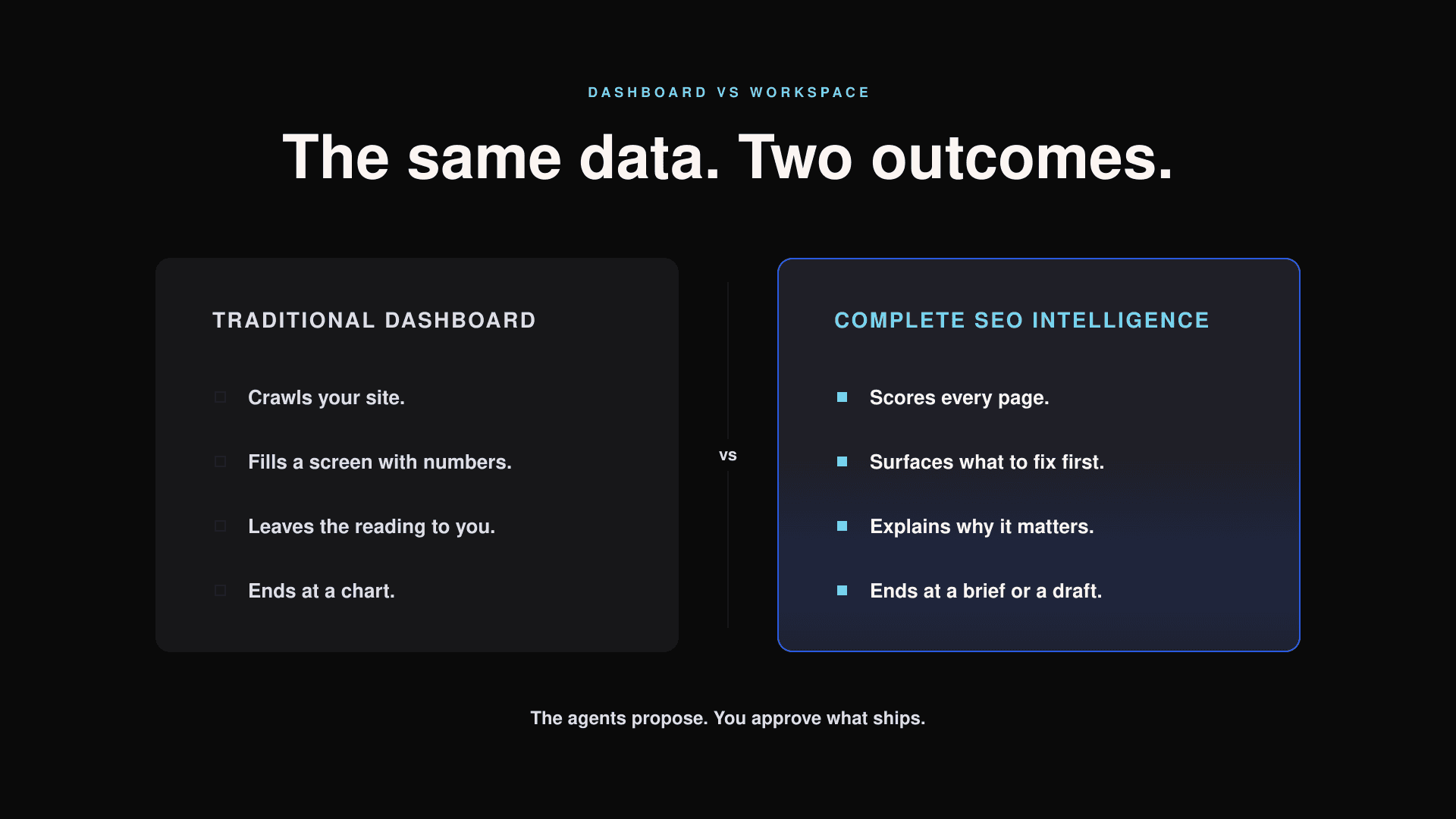
It's a workspace where AI agents perform SEO analysis and then tell you what to act on, rather than presenting raw data for you to interpret. The difference is the output. A dashboard ends at a chart. A workspace ends at a recommendation, a brief, or a drafted fix.
How it differs from a dashboard or a single AI chatbot
A traditional SEO dashboard is passive. It reports the state of your site and waits. You decide what the numbers mean and what to do about them.
A single AI chatbot is reactive. It answers well, but only the question you thought to ask. If you do not know how to ask about keyword cannibalization, it stays silent.
Our SEO Intelligence is proactive. It surfaces the work before you ask, it explains why the work matters, and it produces the artifact you need to act: the brief, the roadmap entry, the page draft. You stay in control of what goes live, but you are not the one digging through reports to find the next move.
Three things that make Complete SEO Intelligence different
1. Agents that lead, not agents you steer
Most agentic tools wait for the right prompt. Complete SEO Intelligence surfaces the work and names the next move before you ask. The SEO Agent runs the audit, finds what is holding your rankings back, and tells you what to fix first. You do not have to know the right question. The workspace tells you the question and then answers it.
2. The value sits in the agent, not the dashboard
The agents do not stop at a chart. Ask about a traffic drop, and you get the answer with the chart behind it, plus the follow-on work: the brief to fix it, the suggested change, and a drafted blog post when you want one. The analysis and the output live in the same place, so the work moves from "here is a problem" to "here is the fix to approve" without a handoff to another tool.
3. Cause and effect you can see
Annotate a change, a Google core update, or a new headline, then watch what it did to your traffic over the following weeks. This is the measurement most teams cannot do without a manual spreadsheet, and it matters more than ever in 2026. With a March 2026 Google core update reshaping rankings inside the same window that AI Overviews kept expanding, knowing whether your traffic moved because of your work or because of an algorithm shift is the difference between a confident decision and a guess.
What the three agents do
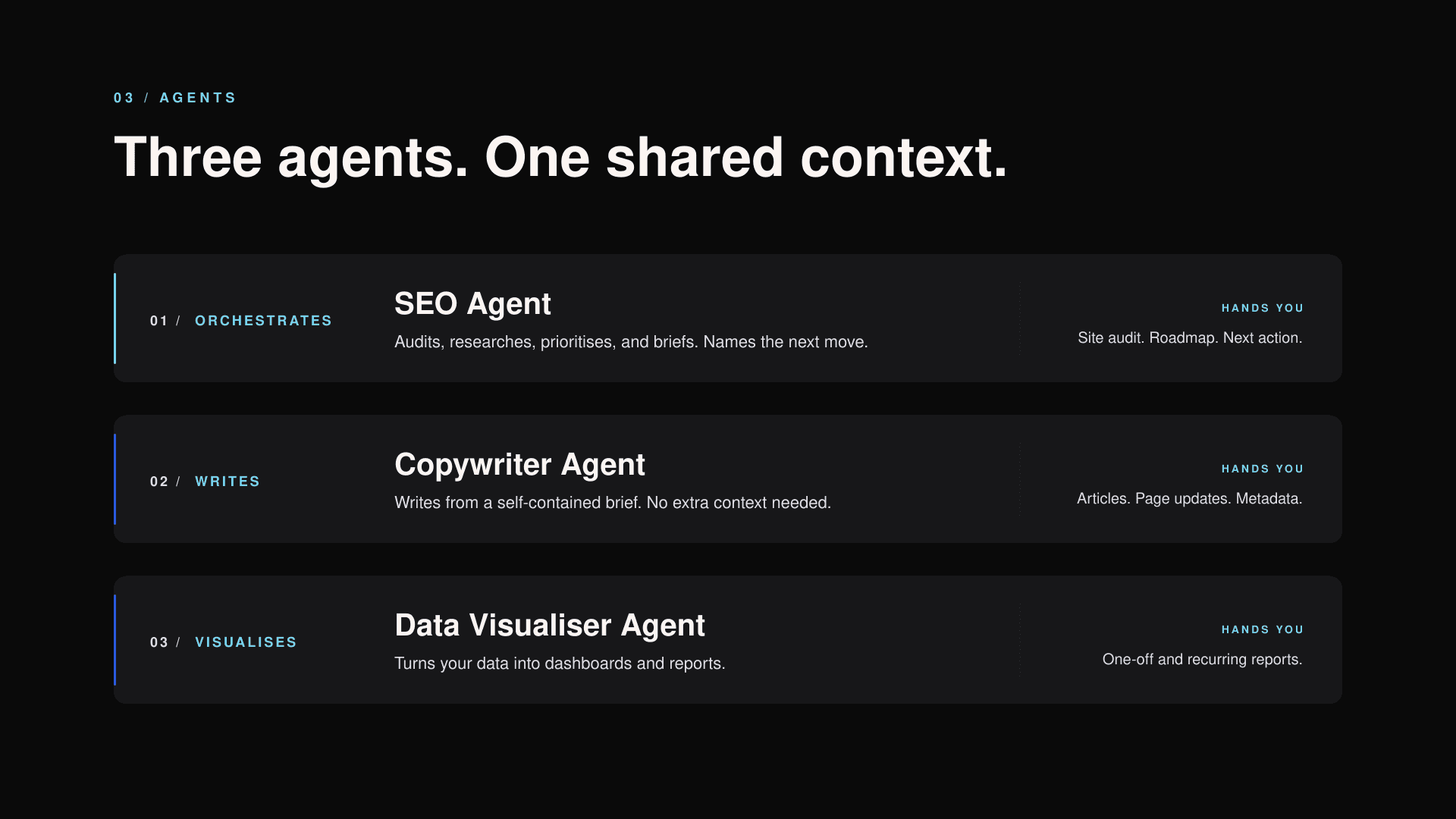
Complete SEO Intelligence is one workspace with three specialist agents that share context. One brief flows through all three, so nothing gets re-briefed from scratch.
Agent | What it does | What it hands you |
|---|---|---|
SEO Agent | Orchestrates the work: audits, researches, prioritizes, and briefs. Recommends the next move at every step. | A scored site audit, a prioritized roadmap, and the next action |
Copywriter Agent | Writes from a self-contained brief, no extra context needed. | Articles, page updates, and metadata ready to review |
Data Visualizer Agent | Turns your data into dashboards and reports. | One-off or recurring visual reports |
The SEO Agent leads. The other two execute from its briefs. You approve every output before anything reaches your site.
What you can do with it
Grouped by the job you are trying to get done.
Analysis and insight
Full site audit with every page scored: Pass, Needs Work, or Critical, with flags for thin content, missing or duplicate metadata, keyword cannibalization, and orphan pages.
Keyword and competitor gap analysis: grouped into topic clusters by priority, search intent, and business relevance, so you know where you can win.
Rankings view: winners, losers, and top 10 at a glance.
Opportunities view: pages rising in position that already earn clicks and impressions, so effort lands where it pays off.
Indexing health: indexed, not indexed, and at-risk pages, including rich results. Many SEO tools never surface this.
Seasonality view: clicks per page per month, so you can time a refresh before the peak and build a content calendar from real demand.
The agent, where the value sits
Ask anything in plain language and get the answer in chat, with the chart to back it up.
Follow up for granular detail, a copy improvement, or a drafted blog post.
Proactive guidance that tells you what to fix first, without you knowing what to ask.
Action and output
Prioritized content roadmap with clear actions, Create, Update, or Consolidate, ranked by impact, effort, and relevance.
Ready-to-write briefs with keywords, intent, titles, outline, word count, and internal links, handed straight to the Copywriter Agent.
Change tracking through chart annotations, so you can measure what each change did.
Workspace and control
One dashboard for search, traffic, and content data, with no tool-switching.
Multiple sites or clients in one workspace, with a per-client overview, ready for agencies.
Agent-guided onboarding that connects the tools you already use and works with whatever you have. If a source is missing, it tells you what connecting it would add.
Human in the loop: every output is a draft until you approve it.
How an AI SEO workspace fits a zero-click, AI-search world
The strategic shift in 2026 is from ranking position to multi-surface visibility, and from optimizing only for Google's blue links to optimizing for AI answers as well. This is where SEO meets answer engine optimization (AEO) and generative engine optimization (GEO), the practice of structuring content so AI systems cite it.
According to Search Engine Land's coverage of effective GEO, the strongest approaches cluster into three moves: expanding semantic coverage of a topic, increasing factual density with data and citations, and using structured data such as schema, FAQs, and tables. An AI SEO workspace supports all three at the source. The audit flags thin and duplicate content that AI systems skip. The gap analysis maps the topic coverage that earns citations. The brief specifies the structure, headings, and internal links that make a page easy for both crawlers and answer engines to parse.
You still need a human strategy on top. The workspace does the analysis and drafts the work. You decide what ships, which is the right division of labor when a single wrong page can cost visibility across multiple surfaces at once.
Who it is for
In-house SEO managers and content marketers who want the analysis done and the next move named, without exporting four reports to find it.
Agencies and SEO professionals managing multiple clients who need a per-client overview and briefs they can hand to writers without re-explaining context.
Founders and growth marketers with no deep SEO background who need the workspace to tell them what to fix first and why.
The common thread: you want decisions and drafts, not another dashboard to interpret.
FAQ
What is an AI SEO workspace? An AI SEO workspace is software where AI agents run the SEO analysis and then recommend what to act on, rather than showing you raw data to interpret yourself. Complete SEO Intelligence uses three agents to audit your site, prioritize fixes, and produce ready-to-use briefs, with every output held for your approval.
How is AEO different from SEO? SEO optimizes for ranking in a list of search results. Answer engine optimization (AEO) optimizes for being cited inside an AI-generated answer. In 2026 you need both, because AI Overviews appear on roughly half of Google searches and resolve many queries before a user clicks. A workspace that flags content gaps and enforces clear structure supports both at once.
Does an AI SEO workspace replace my SEO team? No. It removes the manual analysis and drafting, not the judgment. Every audit finding, brief, and draft is a recommendation you review and approve before it reaches your site. The workspace decides what to surface. You decide what goes live.
Does it work with the tools I already use? Yes. Onboarding is agent-guided. The SEO Agent walks you through connecting your existing search, analytics, and SEO data sources, then works with whatever you have connected. If a useful source is missing, it tells you what connecting it would add.
Can agencies manage multiple clients in one place? Yes. The workspace supports multiple sites or client accounts side by side, with a per-client overview, so you can run separate engagements without separate logins or spreadsheets.
Why does change tracking matter in 2026? Because rankings now move for two reasons at once: your edits and frequent algorithm updates. Annotating a change and watching its traffic impact over the following weeks lets you tell the two apart, so you can repeat what worked and stop guessing.
The takeaway
Search in 2026 rewards teams that turn data into the right decision fast, and penalizes the ones still stitching reports together by hand. An AI SEO workspace closes that gap. Complete SEO Intelligence does the analysis, names what to fix next, and drafts the work across three agents, while you keep approval over everything that ships.
If you want to see it on your own data, sign up and run your first audit. If you would rather walk through it with the team first, contact us for a demo.