Claude Code Alternative: Run AI Coding Agents in a Team Workspace | Complete
In a world dominated by smartphones and digital platforms, App Development has become the backbone of modern business. Whether you're launching a new startup or optimizing internal operations, having a well-built app can give you a competitive edge
If you've used Claude Code, you know exactly where it stops.
It's genuinely impressive at writing code. Give it a well-scoped task and it'll scaffold a service, wire up routes, handle edge cases you'd have missed. But then it hands the code back to you. You still run the deployment. You still configure the environment. You still manage the pipeline, run the tests, handle the PR. The AI wrote the code. You shipped it.
That boundary — between writing and running — is where most AI coding tools live. Complete's Coder agent operates on the other side of it.
Introduction to Agentic AI
Agentic AI marks a new era in artificial intelligence, where autonomous software systems—known as AI agents—are designed to perceive their environment, reason through complex scenarios, and act independently to achieve defined goals. Unlike traditional automation, which relies on rigid scripts and constant human oversight, agentic AI empowers these agents to learn, adapt, and make their own decisions in real time. This shift enables AI agents to tackle tasks that previously required human judgment, from orchestrating software development pipelines to managing dynamic business processes. As agentic AI becomes more widely adopted, industries like software development, customer service, and sales are poised to benefit from more flexible, scalable, and efficient solutions that go far beyond the limitations of conventional automation.
The Deployment Gap: What "Real Deployment" Actually Means
There's a meaningful difference between a tool that generates deployable code and one that deploys it.
Claude Code runs in your local environment or a sandboxed context. It has no persistent process, no outbound networking, no URL registry. It produces artifacts. What you do with them is your problem.
Complete's Coder agent runs inside a persistent VM with full outbound networking and platform-managed port allocation. When it deploys an application, it:
Registers the app to receive a stable HTTPS endpoint — not
localhost:8000, not a temporary tunnelLaunches the process with
nohupso it persists beyond the sessionRoutes logs to structured JSON for observability
Pulls secrets from the platform's secret store — no hardcoded credentials, no
.envfiles committed by accident
The result isn't a prototype you can demo. It's a running application you can hand to a user.
That distinction matters more than it sounds. Prototype environments create a false ceiling — you can validate logic, but you can't validate behavior under real network conditions, real latency, real auth flows. The Coder agent's VM environment removes that ceiling entirely.
Core Components of AI Workflows
At the heart of modern AI workflows are several core components that enable AI agents to operate effectively in complex environments. Large language models serve as the foundation, allowing agents to interpret and generate human-like language, which is essential for understanding requirements and communicating with users. Tool integration is another critical element, connecting AI agents to enterprise systems and specialized tools so they can execute tasks, retrieve data, and interact with existing processes seamlessly. Memory systems—both short-term and long-term—equip agents with the ability to retain context, learn from past interactions, and refine their behavior over time. In advanced setups, multi agent systems bring together specialized agents, each focused on different aspects of a workflow, to collaborate and solve complex tasks that would be challenging for a single agent. This orchestration of large language models, tool integration, and memory systems forms the backbone of production-ready AI workflows in enterprise environments.
How the Coder Agent Works: The Developer Lens
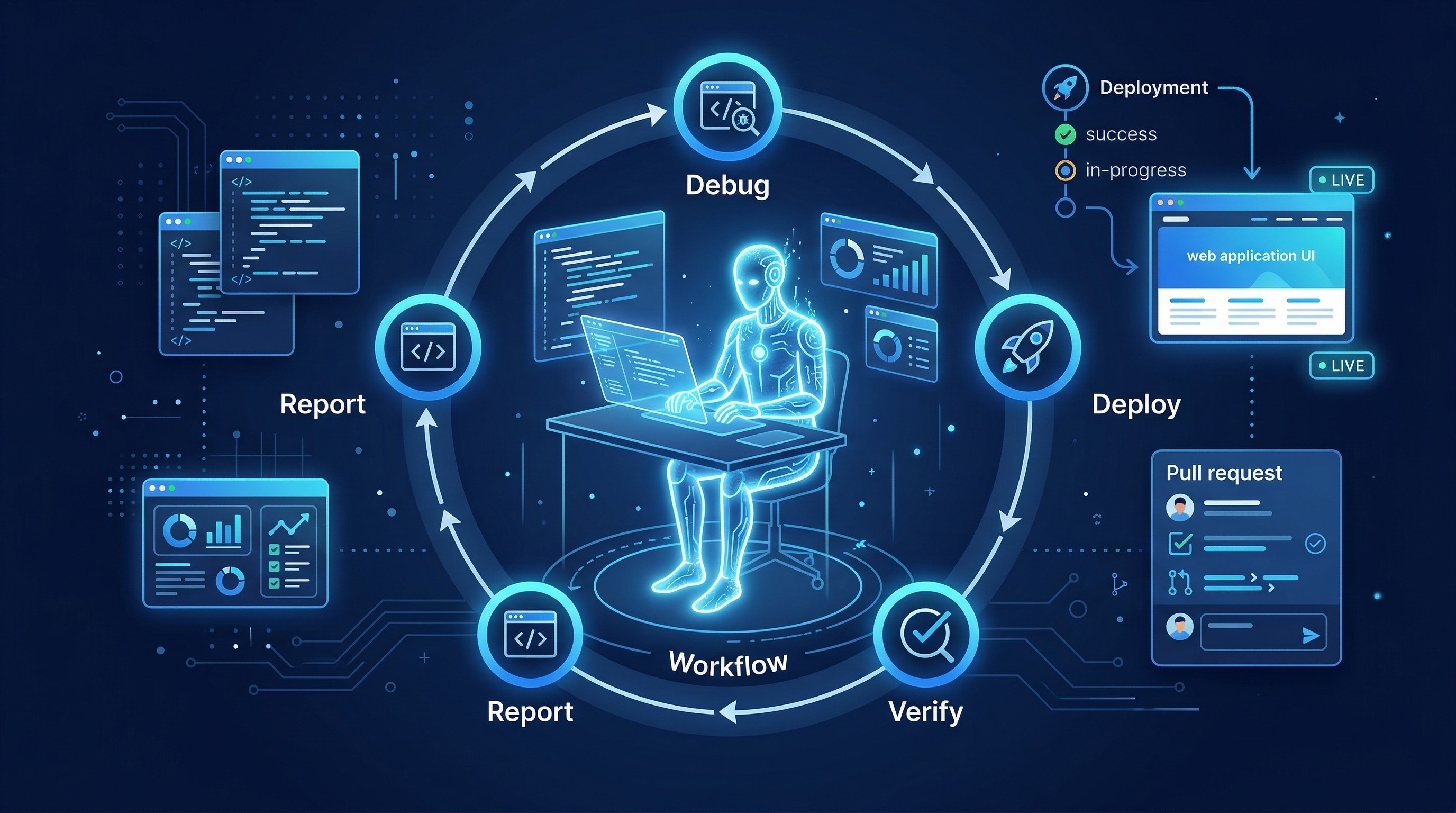
The workflow is straightforward, but the discipline behind it is what makes it trustworthy.
Task intake: You describe what you need in natural language. The agent asks clarifying questions before writing a line — specifically on architecture decisions, language/framework choices, and business logic that can't be inferred. It doesn't guess on things that matter.
Planning: Before any code is written, the agent maps the solution: what to build, how to structure it, which services to integrate. This is visible to you. You can redirect before execution starts.
Execution: The agent builds across multiple files, configures environment variables from the secret store, registers the app, and deploys. All of this happens inside the VM — no local environment required on your end.
Git discipline: The agent works exclusively in feature branches. It uses conventional commit messages. It does not push to main or dev without explicit approval. It surfaces a PR when the work is ready for review.
Verification: After deployment, it runs Playwright-based E2E checks against the live URL — not against a mock, against the actual running application. If something fails, it diagnoses, attempts one recovery, and escalates with a plain-language summary if that fails too. No raw stack traces dumped into chat.
Handoff: You get a PR, a live URL, and a summary of what was built and tested. You review the outcome, not the process.
Artificial Intelligence and Decision-Making
Artificial intelligence has fundamentally changed how decisions are made within organizations by equipping AI agents with the ability to analyze vast amounts of data, recognize patterns, and make informed choices autonomously. These agents operate based on sophisticated algorithms and structured data, often without the need for direct human intervention. However, as AI agents take on more responsibility, ensuring their decisions align with business rules and compliance requirements becomes critical. Robust error handling, transparent feedback loops, and regular human review are essential to maintain accountability and trust in agentic systems. By combining the efficiency of autonomous decision-making with mechanisms for human oversight and intervention, organizations can harness the full potential of artificial intelligence while safeguarding against unintended outcomes.
Multi-Agent Collaboration: A Workforce, Not a Tool
Claude Code now supports multi-agent orchestration through Agent Teams — so the question isn't whether you can coordinate agents, it's what that coordination actually looks like in practice.
In Claude Code's Agent Teams model, you're still the orchestrator. You configure which agents run, define how they hand off, and manage the coordination layer. It's powerful, but the integration work lives with you.
Complete's architecture is different. The Coder agent doesn't need to be orchestrated — it operates natively inside a multi-agent workforce where product, strategy, copywriter, SEO, and code agents share the same channels and pass structured outputs to each other automatically. There's no configuration layer to maintain. No custom glue code. The coordination is built into the platform.
In practice: a product agent scopes a feature, the strategy agent defines requirements, the Coder agent builds and deploys it, and the output feeds back into the broader workflow — all without a human manually passing context between steps. The architecture is message-passing over shared conversation channels. Each agent's output becomes structured input for the next.
The human role in this system is architect. You set direction, define constraints, approve outputs. The agents execute within that scope. When a decision falls outside the agent's defined authority — an ambiguous requirement, a protected branch, a critical architectural choice — it escalates rather than proceeding.
The practical difference: with Claude Code Agent Teams, you build the workforce. With Complete, you join one.
Concrete Walkthrough: Spec to Live Deployment
Here's a recent task, step by step, with no human intervention mid-task:
Spec received — Product specification delivered in chat from the product agent
FastAPI backend scaffolded — Full project structure, route definitions, dependency injection, error handling
Environment configured — Variables pulled from the platform secret store; no credentials in source
App registered — Stable public HTTPS URL allocated via the platform URL registry
Deployed — Process launched with
nohup, structured JSON logging enabledVerified — Playwright E2E tests run against the live URL; all health checks passed
Committed — Changes committed to a feature branch with conventional commit messages
PR surfaced — Pull request opened for developer review with a summary of what was built and tested
The developer's involvement: writing the spec, reviewing the PR. Everything between those two steps was owned by the agent.
For comparison: scaffolding a FastAPI backend, wiring up a secret store, deploying to a live URL, and running E2E verification is a half-day task for a competent engineer doing it manually. That's not accounting for context-switching, environment setup, or the inevitable debugging cycle when something doesn't work in production that worked locally.
What You Control, What the Agent Controls
This boundary is worth being explicit about, because it's where trust is built or lost.
You control:
Architecture decisions — what to build, how to structure it, which services to use
Technology choices — language, framework, infrastructure
Approval gates — nothing merges to
mainordevwithout your sign-offEscalation resolution — when the agent hits an ambiguous decision, you make the call
The agent controls:
Implementation — writing, debugging, refactoring across files
Deployment — VM configuration, process management, URL registration
Verification — test execution, health checks, log monitoring
Git hygiene — branching, commits, PR creation
The line is: you own the decisions, the agent owns the execution. That's not a limitation — it's the correct division of labor. Architectural decisions require context and judgment that lives with you. Implementation execution is where the agent adds the most value.
Getting Started: Handing Off a Task
The interface is a chat channel. No CLI setup, no IDE plugin, no configuration file.
Describe the task. Be specific about constraints that matter — stack preferences, integration requirements, performance targets. The agent will ask about anything ambiguous before starting. Once you've aligned on approach, it executes and reports back.
For developers used to managing every step of the pipeline, the adjustment is mostly psychological: you're reviewing outcomes, not supervising process. The PR is your control point. The live URL is your verification. The agent handles everything in between.
If you want to stay closer to the implementation — review the plan before execution, approve each phase — that's supported. The agent surfaces its plan before writing code. You can redirect, refine, or approve.
Try It
The Coder agent is available on the Complete platform now.
If you're already using Claude Code or Copilot and hitting the deployment ceiling — or if you're building something that needs more than one agent to ship — Complete is worth a serious look.
Start building with the Coder agent →
Complete is the AI workforce platform where developers set direction and agents execute. Python, TypeScript, FastAPI, Next.js, REST integrations, AI-native apps — production-ready, not prototype-ready.